Helping students understand abstract ideas can be challenging, especially when working with diverse learning needs. In my role as a Learning Support Teacher at UWC Thailand, I often look for concrete, visual ways to help students make sense of complex concepts.
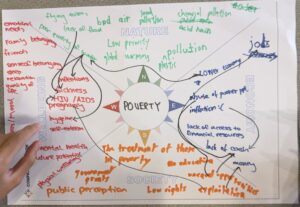
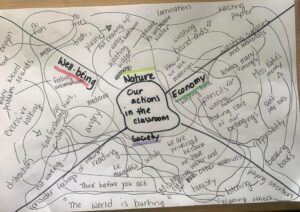
During my Compass Practitioner Level 1 project, I designed a mindfulness lesson using the Sustainability Compass—a framework that organizes ideas into four interconnected domains: Nature (N), Economy (E), Society (S), and Wellbeing (W).
This experience showed me how systems thinking tools can make invisible ideas visible, meaningful, and empowering.
Why Mindfulness + Compass?
Mindfulness is often described as “being present,” but the effects of mindfulness go far beyond personal calm. It influences the way we relate to others, care for nature, make decisions, and engage with our communities.
This lesson was delivered one-on-one to a high school student receiving learning support, using visual and hands-on tools to make abstract concepts more accessible.
Because the Sustainability Compass uses clear visuals and quadrant-based structure, it allowed the student to connect mindfulness to real-world impacts without relying heavily on reading or abstract language.
What Learning Looked Like
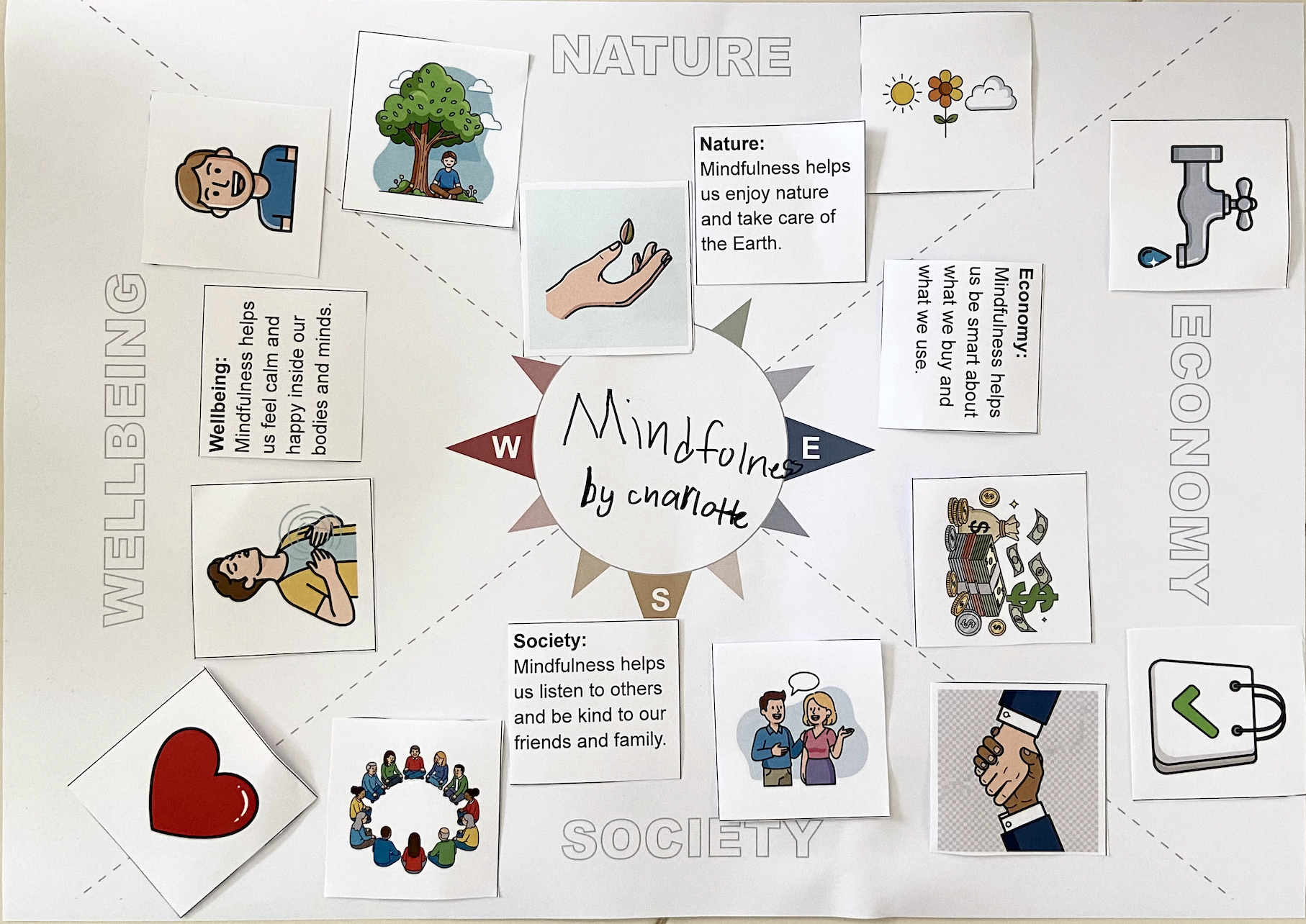
The lesson began with simple definitions of the four Sustainability Compass domains, followed by visual cards representing outcomes of mindfulness such as a tree, a handshake, a calm person, or a heart.
As the student cut and placed the visuals onto the Sustainability Compass, she began making meaningful connections. The key moment came when she placed the heart icon between Wellbeing and Society. She explained that mindfulness “makes me calm, so I can be kind to others.”
This was her systems thinking breakthrough—recognizing that one element can influence multiple domains at the same time. It was not taught; it emerged naturally because the Sustainability Compass made room for it.
Why This Matters for Systems Thinking & Inclusion
This activity reminded me that students with learning differences can thrive in systems thinking when tools are accessible, visual, and flexible. The Sustainability Compass allowed my student to explore interconnectedness without the barrier of complex language.
It also reaffirmed the importance of listening closely to students’ interpretations. Their unique perspectives often reveal deeper system relationships that we adults may overlook.
Looking Forward
I hope to introduce the idea of overlapping Sustainability Compass domains earlier, so students can notice connections across different areas. Using movable pieces, like sticky notes or cards, could help them revise and deepen their maps as their understanding grows. I also plan to bring in more real-life examples, helping students see systems thinking not just as a classroom exercise, but as a way to understand themselves and the world around them.
Through this lesson, both my student and I were reminded that mindfulness is not just a personal practice—it is a systems practice. And with the Sustainability Compass, students of all abilities can learn to see those connections clearly.
Author

Natawadee Srithongdee
Natawadee Srithongdee (Ploy) is a Learning Support Teacher at UWC Thailand with over seven years of experience at the school and more than a decade working with students with special needs. She holds two master’s degrees—one in Special Needs Education from Mahidol University and one in Design Management from the University of Southampton—as well as a Bachelor of Education in Art Education from Chulalongkorn University. Ploy is deeply committed to empowering learning support students and their families and promoting true inclusion through collaboration with professionals from diverse disciplines. She believes that every learner can grow and develop to their fullest potential, and that parents and teachers do not only guide children with special needs — we also learn from them. Her students are her biggest motivation and inspiration, shaping the teacher she is today. She was the co-author of social storybooks for young children with autism and the recipient of the 2024 Outstanding Teacher Award from the Phuket Provincial Education Office. Ploy recently earned her Compass Practitioner (Level 1) certification, continuing her journey in systems thinking and sustainable education.