SYSTEMS THINKING FOR SUSTAINABILITY
IN THE CLASSROOM AND BEYOND

Introduction to the Compass Tools
Virtual Workshop Series

Are You Facing These Challenges in Your School?​

📌 The world feels overwhelming or disconnected from daily teaching.
Too many big issues, not enough simple ways to explain them — especially in ways students care about.

📌 Teachers feel alone trying to build a culture of sustainability.
Changing school culture takes time — and you may not have support or the tools to move forward confidently.

📌 Systems thinking seems abstract and hard to implement.
You want students to think deeply about complexity, but you’re unsure how to do that in your curriculum.

📌 Your school wants sustainability goals — but lacks a clear plan to embed them into teaching.
Ideas are great — but turning them into action that sticks is another step.

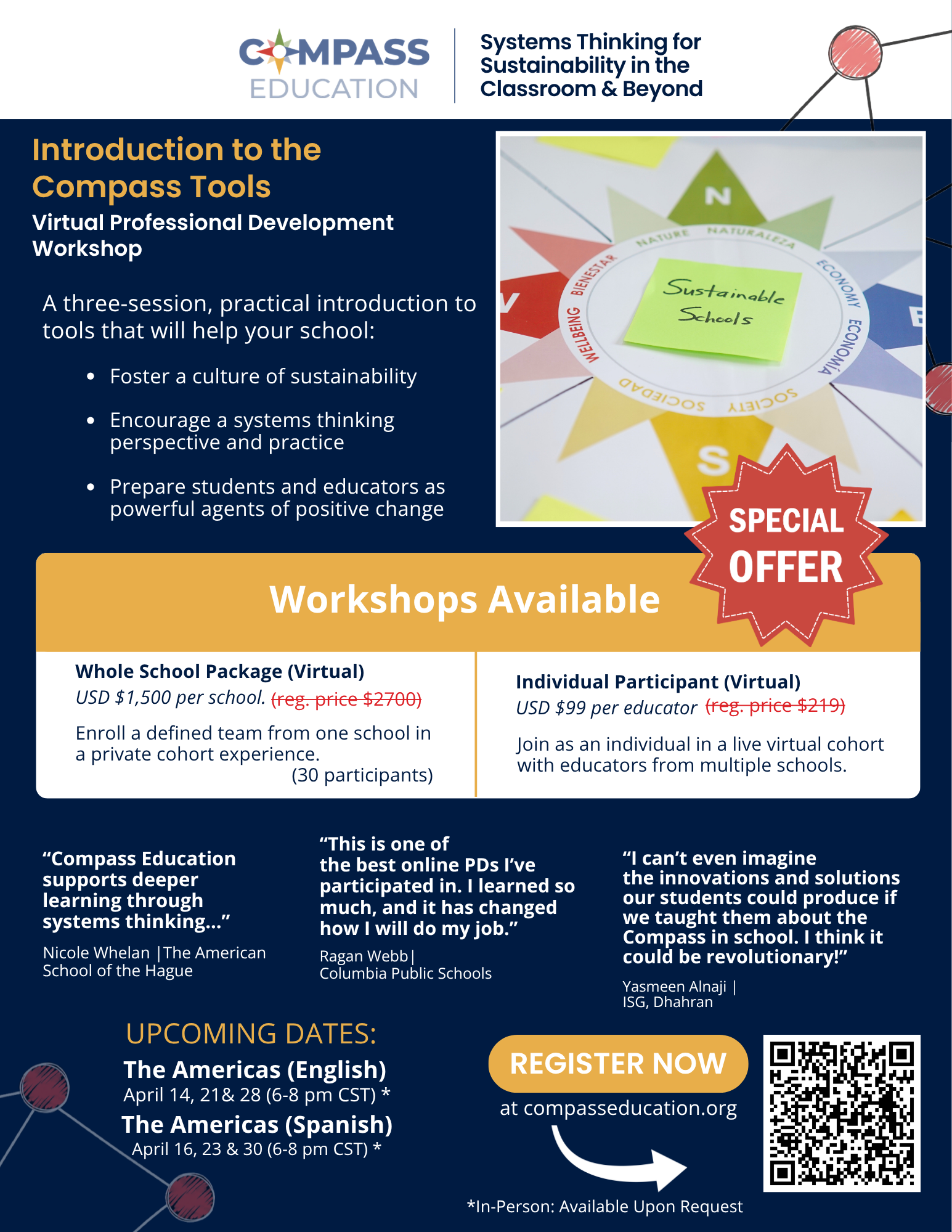
Compass Education is pleased to offer a virtual Introduction to the Compass Tools workshop series, Systems Thinking for Sustainability in the Classroom and Beyond. Available at a special cohort rate for schools and regional groups across the Americas, Europe, and Africa, this interactive experience takes place online over six hours, delivered through three dynamic and engaging sessions that equip participants with practical tools to bring systems thinking and sustainability into their classrooms and communities. This isn’t just another professional development workshop — it’s a hands-on journey into seeing the world through patterns, connections, and systems that students care about.

Who is eligible to register:
  • Any classroom educator, curriculum leaders or school administrator who is eager to bring sustainability and systems thinking into their classrooms, communities, and culture
  • Anyone who works in education and cares deeply about integrating systems thinking and sustainability into their social impact work

Compass Education is pleased to offer a virtual Introduction to the Compass Tools workshop series, Systems Thinking for Sustainability in the Classroom and Beyond. Available at a special cohort rate for schools and regional groups across the Americas, Europe, Africa and MENA, Asia and Australasia regions, this interactive experience takes place online over six hours, delivered through three dynamic and engaging sessions that equip participants with practical tools to bring systems thinking and sustainability into their classrooms and communities. This isn’t just another professional development workshop — it’s a hands-on journey into seeing the world through patterns, connections, and systems that students care about.

Who is eligible to register:
  • Any classroom educator, curriculum leaders or school administrator who is eager to bring sustainability and systems thinking into their classrooms, communities, and culture
  • Anyone who works in education and cares deeply about integrating systems thinking and sustainability into their social impact work
This workshop is available at a special cohort rate!


USD $149 per person
 —Standard rate (for international school educators, paid by the school; additional processing required)
USD $99 per person — Individual rate (for international school educators, self-funded)
USD $49 per person — Reduced rate (for public and government school educators)
USD $19 per person — Accessible rate (for any educators for whom the above prices represent a barrier to access)

School Cohort

$ 1,500 per school (for up to 30 staff members)
  • Compass Education trains educators in over 1,000 schools and organizations worldwide
  • Deepen learning and support school-wide sustainability goals—from curriculum development to student-led action
  • Sessions can be scheduled at any point throughout 2026
Popular

Regional Workshops

$ 99 per person (Individual rate)
  • The Americas Region (in English) - April 14, 21& 28 (6-8 pm CST)
  • The Americas Region (in Spanish) - April 16, 23 & 30 (6-8 pm CST)
  • Asia Region - April 28, May 5 & 12 (6-8 pm UTC+8)
  • Europe Region - May 5, 12 & 19 (5-7 pm CEST)
  • Africa & MENA Region - May 7, 14 & 21 (4-6 pm CAT)
  • Australasia Region - May 26, June 2 & 9 (4-6 pm AEST)
NEW

How This Workshop Helps

🌱 Understand Sustainability in a Practical, Actionable Way
This workshop introduces the Sustainability Compass and Systems Iceberg — two tools that make complex ideas accessible and teachable, not vague buzzwords.

🛠️ Practical Tools You Can Use Tomorrow
You won’t just learn concepts — you’ll walk away with tools and frameworks that can be immediately applied in lessons and projects.

👩‍🏫 Build Confidence with Systems Thinking
Whether you’ve never heard of systems thinking or want to deepen your practice, this series shows you how to use these ideas with students, in any grade or subject.

🌍 Collaborate with a Global Educator Community
Connect with other educators in your region who are working toward sustainability goals — exchange ideas, develop curricula together, and feel supported rather than isolated.

🎯 Turn Ideas Into Action Plans
You’ll finish the series with a clear plan to integrate systems thinking into your classroom or school community. This isn’t just inspiration — it’s implementation.

Session 1: Introduction to Systems Thinking with the Sustainability Compass

This session highlights a tool called the Sustainability Compass which engages us in systems thinking - a way of looking at the world that emphasizes interconnectivity and interdependence. We will demonstrate ways that this powerful tool can integrate into your teaching and learning plans to help learners think critically and deeply about the topics they study and our global community.

Sustainability Compass showing four interconnected domains: Nature, Economy, Society, and Wellbeing

Session 2: Using the Iceberg to Deepen Our Understandings

This session dives deep into using the Systems Iceberg Model, a systems thinking tool designed to evaluate a problem or event by examining the root causes, underlying structures and mental models that can trigger it. As we deepen our understanding, we can develop new perspectives and more effective and sustainable solutions.

toolkit-05

Session 3: Action Planning and Curriculum Design

We will study examples of curriculum design in a broad range of topics, age groups and subjects. Participants will be able to work independently or in small groups to design an action plan or curriculum plan to engage their students in climate education and/or civic action using systems thinking.

Action Planning

Learning Outcomes

Who should participate?

• Any classroom educator or school administrator who is eager to bring sustainability and systems thinking into their classrooms, communities, and culture
• Anyone who works in education and cares deeply about integrating systems thinking and sustainability into their social impact work

Time Expectations

This workshop series will be delivered virtually (six hours) in three sessions formats.

Certifications

After completing this workshop, participants are eligible to continue their learning on our online certification workshop ‘More Systems Thinking Tools for Sustainability in the Classroom’’. This course contains 6 hours of additional content on systems thinking tools and sustainability and includes a 1-1- meeting with a Compass Facilitator to discuss their learning or action plan. Completing this course leads to ‘Compass Practitioner’ Certification- a globally recognized certificate in education for sustainability.

What will you take away from this workshop?

• A shared language for whole faculty or school conversations about sustainability and systems and framework for reflecting on issues systemically.
• Powerful conversations making sense of complex issues.
• Lesson ideas that educators can use in their classrooms the next day, next week or as soon as they’re ready!
• Useful tools that can integrate sustainability and systems into any curriculum and every class level.
• Access to our database of educator sourced lesson plans.
• Connection to a global movement of educators for sustainability education.
• The opportunity to apply for additional free learning and certification as a Compass Practitioner.