A deep breath. We’ve each chosen a place in nature to sit and now I am using all my senses to notice the natural world. I see a skylark way up above me, I hear its warbling warning to stay away from its nest. Another breath in and I can smell the herbs growing nearby and I can almost taste the rain-soaked earth. I feel the breeze on my face and the light gusts moving my hair. Another deep breath and my fellow gardener prompts me to notice the ground beneath me, solid and reliable.
Five minutes of connecting with Nature; I open my eyes and everything is brighter, calmer and I feel that I am part of nature in my local community garden.
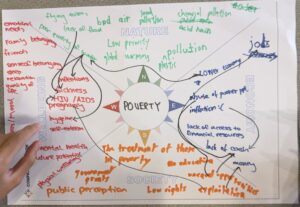
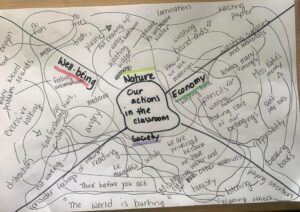
I have recently completed a nature connection course based on the five pathways to nature connection developed by the University of Derby: contact (through our senses), emotions, beauty, meaning and compassion allow us to connect more deeply with the natural world. The course encouraged us to see ourselves as we truly are; a part of Nature’s Systems. It is through this deeper connection with nature that pro-environmental behaviours are commonly seen, not just the naming and knowledge-based understanding of our natural world. During the course we were encouraged to think about how our human systems connect to Nature’s systems. “Aha!” I thought, “I know a great tool to support that thinking, the Compass!”
My colleague and I thought about using these techniques when working with volunteers and school groups back in our community garden setting. Connecting our community to the land and nature around us, as well as to the food we grow is an important aspect of the educational programme that we are beginning to develop at Community Roots, a community garden near the sea in Cornwall, UK.
We had a few sessions with school groups coming up so we decided to use the Compass as a reflection tool at the end of their session which had been a practical, hands-in-the-earth kind of morning followed by a feast made of the food that they had harvested.

The Compass allowed the children to see how their food and the garden whilst being human systems were deeply rooted in and connected to Nature. It also allowed them to reflect on how nature supported their wellbeing and sense of connection to each other and their community.
We’ve found that by taking a few minutes, whether during these educational visits or when working with our fellow volunteers, to connect with nature has powerful results not only in terms of their connection to nature but also for their sense of general wellbeing. Noticing the beauty, ingenuity and cycles of nature has a ripple effect that allows me to place myself more definitely in this place and I hope that it has the same impact on others whether they see themselves as systems thinkers or not.
I dipped into these texts when thinking about this blog post:
- “Beyond Ecophobia. Reclaiming the Heart in Nature Education” David Sobel
- “Reconnection. Fixing our Broken Relationship with Nature” Miles Richardson
- The nature connection course that I went on was run by The Natural Academy based in the UK
- The wonderful community garden where I’ve been volunteering and thinking about connecting kids to nature is the Community Roots