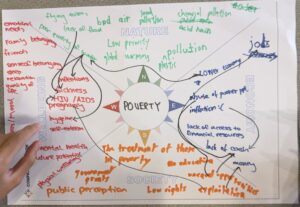
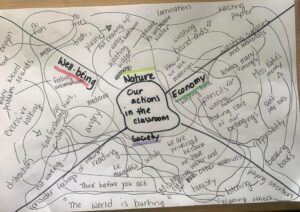
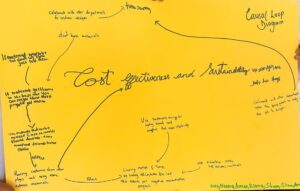
By participating in the More Systems Thinking for Sustainability in the Classroom workshop, I became more familiar with the Systems Iceberg and the Sustainability Compass. It was helpful to practice using both of these tools in a small group setting. I also enjoyed connecting with other educators who have similar goals and mindsets.
I plan to teach my lesson to my student green team, which includes third and fourth graders. The issue I plan to address is paper overuse at school, which we began to focus on near the end of the school year. Students learned about the life cycle of paper, including the many transportation steps, and they created a skit. The skit was recorded and will be shared with the school.
First, I plan to introduce the Systems Iceberg using the familiar problem of litter on the playground. Using a dry-erase board, we will start at the top and work our way down the Iceberg. While there will likely be some input from students, I will have pre-identified what will go in each layer. This model will help students become familiar with the Systems Iceberg.
Then, we will create another Systems Iceberg, starting with the event/issue, “The school uses too much paper.” I will put students in pairs and give each an idea that belongs in the Iceberg. Each pair will be asked to think about where their idea might go. As a whole group, we will discuss each layer and determine where each idea belongs. The discussion will involve me asking prompting questions and providing time for students to think and pair-share.
Once the Iceberg is complete, I will ask students which points they think can make the most change (define leverage points), and we will decide on one to focus on. Finally, we will come up with a plan to address that leverage point.
Author

Britni Cacan
Britni lives in the beautiful Willamette Valley in the state of Oregon, U.S. She is a former classroom teacher at the elementary level, and her passion is learning and teaching about sustainability topics. Currently, she leads a student “Green Team,” which is an after school group that works on making the school more eco-friendly. They recently led the school to become certified as an Oregon Green School.
She also manages the school garden and nature space. Additionally, she has volunteered as a Compost Specialist and Master Recycler through Lane County, Oregon, and she has facilitated educator workshops on sustainability education.