Why the SDGs need habits
If someone said to you: “Make it a habit.”, what would that mean to you? Maybe something you do daily or weekly, and consistently. Maybe it’s a thing you do without thinking about it – you just do it, because it’s an acquired reflex and a trained practice that becomes easier over time and even part of who you are or how you identify yourself. All of this may fit your idea of what a habit is, but actually making something a habit – the how of it – is more difficult than it sounds. It requires time, dedication, and embedding it into your already-busy lifestyle. So how can we make something inherently complex and difficult to achieve, like embedding the United Nations Sustainable Development Goals (SDGs) into our existence as individuals and a global population, a habitual reality? Well, there’s no easy answer (otherwise the SDGs would have been reached already). The good news is that habits, by the very nature of what they are, would be sustainable! But getting the SDGs to become a habit calls for approaches that are manageable, scalable, and collectively meaningful.
The Sustainable Habits Of Mind
Brújula Educación introduced me to the idea of the Sustainable Habits Of Mind – a collection of mindsets that help our thinking focus on systems and sustainability. To summarise them:
- Don’t stress the mess – the world is complex, let’s embrace that.
- Focus on learning, not knowing – systems are continuously changing and so should we.
- Imagine the possibilities – dream big and innovate instead of solving small problems.
- Look for loops – linear relationships only exist in small settings, but broadening our scope allows us to view the factors that are interdependent.
- Learn from nature – its systems are complex and balanced, meaning it has many answers.
- Get perspective – you might have a great idea, but it’s still only one idea from your angle.
- Change your mind – if new information stacks up, it’s important to shift your thinking.
- Think beyond the here and now – past solutions solve current problems, while current solutions may solve future problems even if we can’t see it now.
- Value the unseen – the numbers and the physical evidence is only a part of the full story, while the intangible often has a larger and more human-focused impact than we care to believe.
- Cultivate connection – knowing all things are connected helps us build a love for the way the world impacts us and how we impact the world and each other, fostering empathy for all that exists.
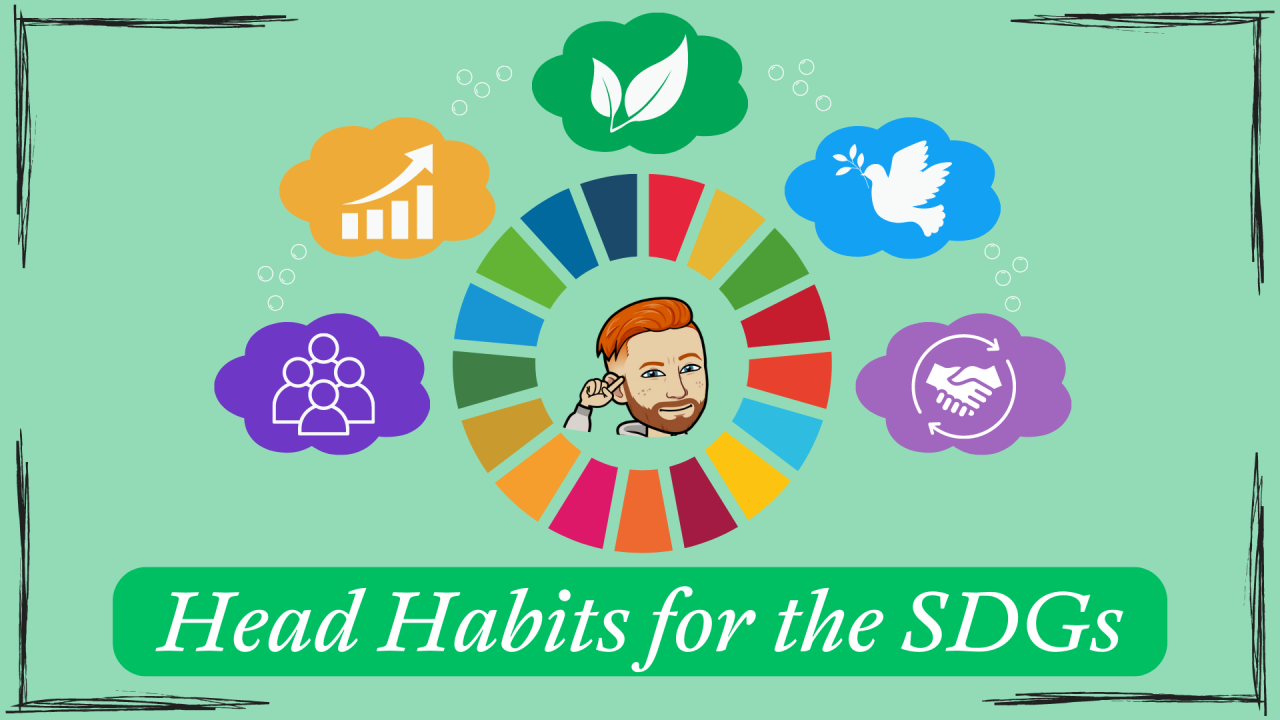
What strikes me about these habits is that they are all mental factors that move us closer to physical action. They all ask us to think deeper about our world and consider our connection and impact. They outline how adopting sustainable habits of mind may help us develop Partnerships to move more naturally toward a world of Peace and Prosperity for our People and Planet: these Five Ps are pillars of a framework that highlight the interconnected and intertwined qualities of SDGs and can be achieved thoroughly and manageably using collectively sustainable habits of mind.
Connecting the Habits to People
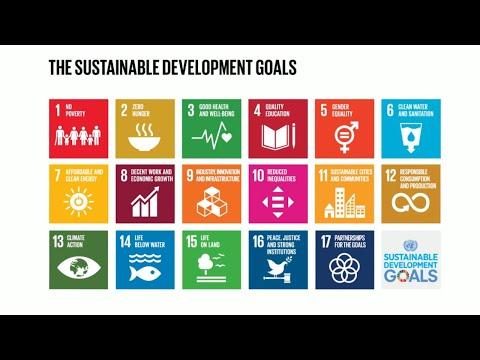
The first pillar is People, centering around care for individuals, communities, and the population as a whole through the first six SDGs: no poverty, zero hunger, good health and wellbeing, quality education, gender equality, and clean water and sanitation. With this in mind, it is important to ‘value the unseen’. Many of our actions are connected to measurable indicators, and actions related to people are no exception. However, when we think of the qualitative or even immeasurable factors of human existence – knowing that what makes us who we are is an overlapping collection of thoughts, ideas, feelings, experiences, and behaviours – it helps us understand that the People SDGs are large concepts with uncovered and sometimes unobservable parts. This implores us to ‘get perspective’ about the lives of others, investigate their lived experiences, and gain their insight surrounding the very problems in their communities that we or they may be trying to solve.
Connecting the Habits to Prosperity
The second pillar is Prosperity, centering around the development of individuals and societies in harmony with nature through the SDGs: affordable and clean energy, decent work and economic growth, industry innovation and infrastructure, and reduced inequalities. Prosperity is often tied to economic gain, which does have profound impacts on other aspects of prosperity relating to human development, but the economy does not need to be driven in one way only. When we ‘look for loops’ within the human-planet interaction and any resulting prosperity, we may start to see that prosperity can come about in a myriad of ways and could utilize economic systems different in focus from what we have today, such as sustainable, circular, and regenerative models. This asks us to ‘change our mind’ when faced with alternative avenues through which our economy may thrive; mechanisms that include the improvement of our planet and human wellbeing by design.
Connecting the Habits to Planet
The third pillar is Planet, centering around the health of the Earth and, by extension, the people that live on it. It connects to the SDGs: sustainable cities and communities, responsible consumption and production, climate action, life below water, and life on land. Our planet is an intricate and quite spectacular system. And it is sustainable! Well, at least without human impact. But, just as we have shown that we have the power to disrupt Earth’s system, we also have the power to intervene for the correction of its balance. The best part about looking for complex solutions to wicked problems is that we can ‘learn from nature’; if Earth as a system, with its subsystems, are all self-sustaining (in the absence of quick and large changes induced by humans) then we can consider it to be a model of excellence and a blueprint upon which we can base the innovative solutions we seek to achieve. If we ‘think beyond the here and now’ to understand that both the disruption and solution-focused intervention to this complex Earth system doesn’t only span vast amounts of space but also across time, we can factor in the scale to which our changes to the system may manifest, from the past and toward the future.
Connecting the Habits to Peace
The fourth pillar is Peace, centering around the interplay between justice, law, and an inclusive society, free from debilitating inconsistencies and discrepancies and with fairness at its core. It connects to the SDG: peace, justice, and strong institutions. Not only does this require frameworks and structures that support peace in societies, but it also asks us as individuals and communities to come from a place of peace in order to understand what it can look like, both within ourselves and its impact on others. If we ‘focus on learning, not knowing’, we may uncover what peace looks like to us and to others, ultimately discovering that peace may look different to different people but is something we all would like to share and sustain. ‘Imagine the possibilities’ of a completely peaceful world, where peace is the status quo and is the very quality we work toward every day to keep achieving – we may find that, in a world such as this, we can focus on the pieces important to our humanity rather than the pieces that dismantle it.
Habitual Partnerships
The fifth and final pillar is Partnerships, an all-encompassing pillar that centers around the SDG of partnerships. Let’s mindmap the idea of global partnerships to see what it could look like: partnerships between the pillars of the 5Ps to have interconnected approaches to global issues, partnerships between individual SDG efforts to harness their unique strengths to solve complex problems, and partnerships between each other to showcase that our collective solutions for the whole (community) are greater than the sum of its parts (individual efforts). Here, we need to tell ourselves: ‘don’t stress the mess’! Partnerships will look different to one another and they will be messy. After all, the concoction of differing ideas from people of different backgrounds and different lived experiences will surely be present when partnerships occur. In fact, this should be the goal. To be messy. To have diversity. To build unrefined solutions that can be reworked, refined, and polished over time as more partners join. Let’s ‘cultivate connection’ between all of us, across the pillars, SDGs, and each other, to gain an appreciation of the complexity of our world and a pathway to, simply, take action.
Visit The AuthentiServe Newsletter by Dominic Verwey about service learning in schools and beyond: https://www.linkedin.com/newsletters/the-authentiserve-newsletter-7063403954700771328/
Author

Dominic Verwey
Driven by family, authentic action, nature, and reflection, Dom is an international school service-learning and leadership educator with a passion for supporting those around him in developing their passions and talents for impactful action, especially young solutionary changemakers. He is inspired by the ways in which we can collaboratively draw on a constellation of knowledge, skills, and dispositions to regeneratively solve some of the world’s deepest systemic challenges. He has an academic background in exercise physiology and neurocognition, and holds a Master’s degree in Climate Change and Development through the University of London SOAS. Dom loves bringing together multiple stakeholders to co-construct new pathways in education, for both inside and outside the classroom.